Sunday, November 13, 2011

The business model and key strategies

How do we develop entrepreneurship.

  • by teaching them business model building
  • incorporating the models with the right strategies in the midst and to encounter competition.
  1. The goal in business is to maximise return -   (ROE chart /  metrics in business)
  2. However, the profit model simulation would determine the right business sizing and the cost parameters.
  3. With benchmarking, gap analysis should identify the SWOT of the business. 
  4. With target market determined, customers profiled, market positioning strategies are then formulated.
  5. Winning strategies are defined as in key result areas with departmental metrics
  6. Performance standards and indicators are established through benchmarking
  7. Efficiency and innovation driven measures for continuous improvement
  8. Goals and metrics are cascaded and coordinated to the lowest job holder
  9. All strategies and changes are linked into a strategic map
  10. summarize the above into a 7 step business plans
  11. Has the goals been achieved?
Copyright :  Arriffin Mansor 012-2786282
----------------------------------------------------------------------------------------


  1. Clear understanding of the business profitability.
  2. Market driven and targeted customers positioning
  3. Understand product concepts
  4. Learn basic business strategies
  5. Understand efficient and effective performance measurement.
  6. Competent in integrated and coordinated key functional strategies
  7. A strong leadership to mobilize all resourcces
---------------------------------------------------------------------------------------------------------------

Competencies of an Entrepreneur - the key


The competency profile of an entrepreneur:
  1. design, develop and create new product of value.
  2. identify market demand opportunity that generate high return.
  3. dare to take business risk
  4. create the right business model to operate the new venture. 
  5. Mobilize resources to conduct the business. (4 Ms)
-----------------------------------------------------------------------------------------------------
  1. Design a realistic, profitable business model.
    • by setting the right price
    • to get the right sales volume
    • matched with the right costs
    • to generate a worthwhile return.
  2. Understand returns to capital or equity as key objective of business
  3. Manage with  minimum capital
  4. understand and relate risks to return
  5. Set the targeted customers and their needs
    • with 4ps
  6. Increase HR productivity through piece rate wages and profit sharing
  7. Raise capital and maximise borrowings through financial leverage.
  8. reduce operational costs through efficiency monitoring.
  9. If possible convert all fixed to variable costs
Copyright:  Arriffin Mansor 012-2786282

Wednesday, November 9, 2011

Kaedah metrik dalam keusahawanan


Banyak latihan keusahawanan diMalaysia berpaksi kepada motivasi dan perniagaan.
(Akibatnya:  tidak ada beza diantara keusahawanan dengan perniagaan)

Kaedah strategi dan matlamat(goals) tidak ditekankan.  Akhirnya usahawan yang dilahirkan menggunakan kaedah biasa menghadapi masalah bersaing dan gagal menghadapi perubahan yang pesat dipasaran.

Kaedah metrik digunakan sebagai alat pada usahawan untuk bersetrategi, mengenalpasti peluang, dapat merancang dengan berkesan, ketahui punca utama untuk mencapai matlamat utama dan kecil yang jelas.

Antara faedah yang dinikmati dalam latihan keusahawanan melalui metrik adalah
  1. Matlamat perniagaan jelas kerana didefinasikan secara quantitatif.  (Goals setting and integrating)
  2. Matlamat boleh dipecahkan kebeberapa komponen dan merupakan Key Result Areas (keberhasilan utama)
  3. Hasil kerja boleh diukur melalui ukuran yang objektif - key performance indicators (petunjuk utama prestasi)
  4. Sasaran prestasi turut jelas kerana menggunakan angka.
  5. Tandaaras dapat dilakukan bagi tujuan penilaian prestasi.
  6. Variasi atau jurang dapat dianalis dengan objektif
  7. Perubahan strategi turut diperjelaskan melalui metrik
  8. Nisbah merupakan metrik utama dalam mengukur dan mempertingkatkan kecekapan
  9. Akhirnya, strategi dapat diaplikasikan melalui pemetaan metrik.
  10. Fungsi utama perniagaan diintegrasikan melalui metrik.
Program Keusahawanan yang hidup, yang ada cerita dalam cerita - yang ada strategi diatas strategi.

Copyright:  Arriffin Mansor 012-2786282

Monday, May 9, 2011

11 ISU UTAMA DALAM KEUSAHAWANAN


Entrepreneurship is about model building with relevant strategies.

  1. Started with gap and depth analysis for identifying market opportunities.
  2. Creating the right product and value.
  3. Managed with the right business models - the right sizing.
  4. Incorporating the right strategic maps
  5. Stood on an integrated functional models


DU PONT ROE CHART


Sales

Sales


Cost of


Goods


Sold


Profits

Profit


Over


Sales


Heads


ROS


Cash

Current


Working Capital

Stocks

Assets


Debtors


Sales

Asset Turnover

ROE


Asset


Current

Current


Liability

Liability


Equity multipliers


Fixed


Land

Assets

Assets


Fixed Capital

Plant/E


Equity


Transport


Computer


The key ratios could be drawn from the above chart.
  1. Overall performance
  2. Liquidity ratios
  3. Gearing ratios
  4. Efficiency ratios
  5. Potential ratios
The above model could be simulated to achieve the right results with realistic strategies.
  1. Business strategies
    • Product strategies
    • HR strategies
    • Marketing strategies
    • Financing strategies
    • Operational strategies
  2. Working capital strategies
  3. fixed capital strategies
  4. Financing Strategies
Design and correlate strategies into a strategic map.

Copyright   Arriffin Mansor 012-2786282

Sunday, April 17, 2011

Metrik dalam perniagaan

FUNGSI
UKURAN-NISBAH
KETERANGAN
Hubungan Metrik
Matlamat Utama
Untung/Modal
Untung / Ekuiti
Untung / Jualan
Jualan / Aset
Aset / Ekuiti
Pulangan ekuiti
BSC perspectives
Pemetaan Strategi
Pemasaran
Jualan 2 – Jualan 1/ Jualan 1
Retention, growth and penetration
Operasi
Kos per unit
KECEKAPAN
Bahan,
Upah
Overhead
Kakitangan
Produktiviti
Profitability per man
Jualan / kakitangan
Untung / kakitangan
Kewangan
Untung /  Aset
Kecairan
Leverage
Kecekapan
Pengurangan modal
kecekapan

Copyright:   Arriffin Mansor  012-2786282

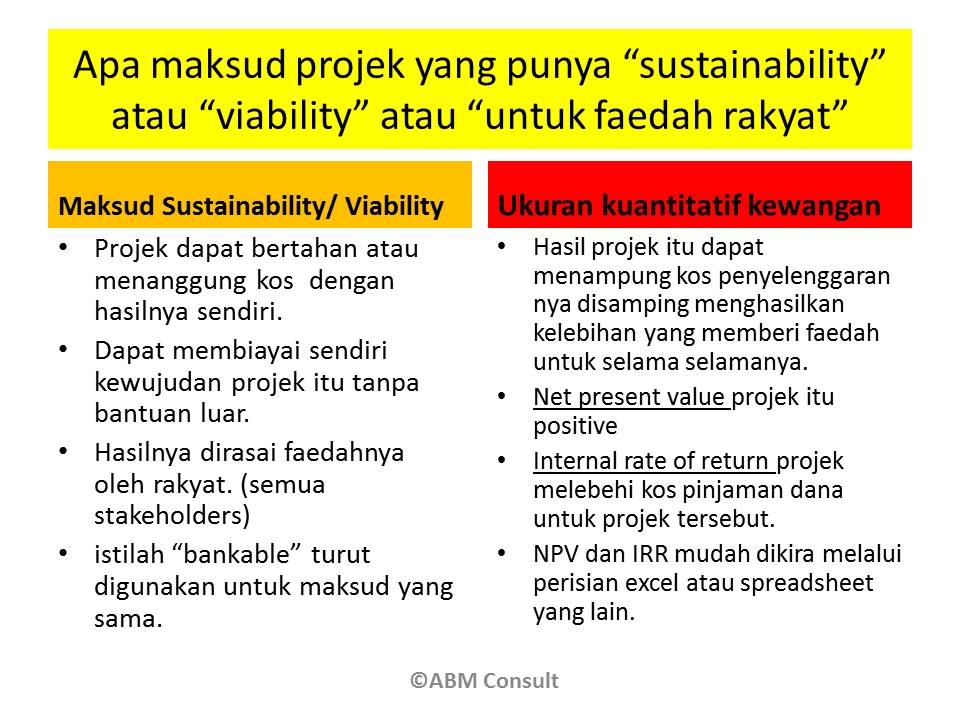
USAHAWAN PERLU FAHAM MAKSUD "VIABILITY ATAU SUSTAINABILITY


Merancang dan membuat keputusan dalam perniagaan dan pengurusan memerlukan angka.
Lebih tepat lagi ialah penggunaan nisbah - satu angka dibahagikan dengan angka yang lain
untuk menghasilkan nisbah yang menunjukkan kecekapan dan prestasi iaitu KPI rate.
  1. Matlamat pernigaan ialah PTE atau PTA adalah nisbah
  2. KPI pasaran seperti kekalan, penetrasi dan pertumbuhan adalah nisbah.
  3. KPI operasi yang utama ialah nisbah kos per unit.
  4. KPI personel ialah produktiviti.
  5. KPI kewangan ialah kos wang dan pulangan
*KPI ialah key performance indicator atau KPI areas.
KPI rate atau kadar adalah angka yang dibuat perbandingan.
KPI rate atau kadar ialah nisbah dimana satu angka dibahagikan dengan angka yang lain.
Contoh:  Output dibahagikan dengan input.

Copyright:  Arriffin Mansor 012-2786282


Thursday, March 10, 2011

Factor, efficiency and innovative driven entrepreneurship


I received a GEM report 2009 on entrepreneurship with special reference to Malaysia from Unirazak today.

The report states that there are 3 types of entrepreneurship - factor, efficiency and innovation.

They are categorised in accordance to countries.

I define entrepreneurship as those that are only innovative driven. Hence, factor and efficiency driven are classified as ordinary business management.

I regret to note that these findings were derived mainly from surveys.


My own perspective of entrepreneurship


3 peringkat keusahawanan